24/7 Flooded Basement Cleanup Across All Michigan Counties
Basements are the ground zero of Michigan water disasters due to expansive clay soils, high water tables, and severe winter freezes. Our mobile teams arrive within minutes to pump out basements, dry finished rooms, and prevent foundation mold.
Michigan’s extreme seasonal climate — from winter polar vortex deep-freezes that rupture supply pipes to torrential spring rainstorms and lake-effect downpours — requires immediate, certified structural restoration. Our statewide mobile units arrive within an average of 45 minutes, fully equipped to stop moisture migration, sanitize contaminated surfaces, and restore your property to verified dry standard.
Pumping completed in hours; complete subterranean drying in 3 to 4 days.
Direct insurance billing via Xactimate. Policyholder is responsible only for applicable deductible.
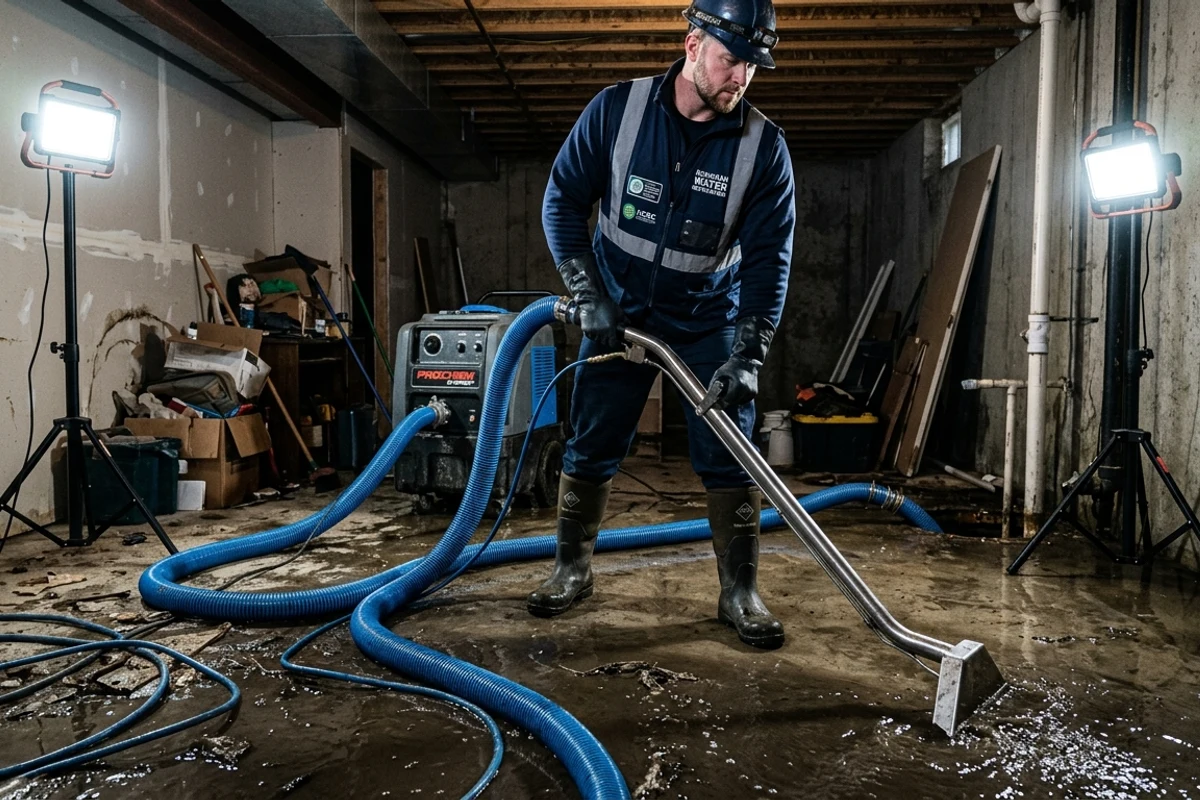
Equipped with truck-mounted high-CFM extractors, LGR dehumidifiers, and thermal imaging cameras.
What to Do in the First 60 Minutes of Basement Flood Cleanup
The first hour following a water loss determines whether building materials can be dried in place or must undergo costly structural demolition. Follow these critical steps immediately while our mobile response unit is en route:
Do Not Walk in Standing Water: If water level has reached electrical outlets or extension cords, remain upstairs until power is disconnected.
Check Sump Basin: If safe, inspect whether the sump pump float switch is stuck or if the discharge line is frozen outside.
Avoid Direct Skin Contact: Groundwater and basement runoff often carry biological contaminants. Wear rubber boots and gloves.
Avoid Running HVAC: Keep furnace and central air off if air returns are near floor level to avoid circulating mold spores.
Cost Breakdown & Pricing for Basement Flood Cleanup in Michigan
Restoration costs in Michigan are governed by standardized Xactimate pricing matrices established by property insurers. We do not use arbitrary pricing; every line item — from water extraction and microbial disinfection to industrial dehumidifier runtimes — is billed at official state-approved rates.
Typical complete restoration cost including emergency mobile dispatch, high-volume extraction, 3–5 day drying cycle, and antimicrobial application.
Standard Michigan square footage pricing for floor, ceiling, and wall structural cavity water extraction and psychrometric dehumidification.
Typically subject to a $500 – $1,000 rider deductible.
Standard Daily Equipment Schedule (Basement Flood Cleanup)
Xactimate regional rate schedule for industrial structural drying equipment deployed on Michigan job sites.
| Restoration Equipment | Standard Daily Rate | Role in Restoration | Insurance Status |
|---|---|---|---|
| Industrial Submersible Trash Pump | $140/day | IICRC S500 structural moisture extraction & humidity reduction | 100% Eligible under Covered Claims |
| High-Capacity LGR Dehumidifier | $135/day | IICRC S500 structural moisture extraction & humidity reduction | 100% Eligible under Covered Claims |
| Centrifugal Floor Air Mover | $35/day | IICRC S500 structural moisture extraction & humidity reduction | 100% Eligible under Covered Claims |
| Antimicrobial Fogger | $95/application | IICRC S500 structural moisture extraction & humidity reduction | 100% Eligible under Covered Claims |
* Note: Equipment runtime is determined by daily psychrometric dry-standard logs. We remove equipment the exact day dry standard is documented to avoid unnecessary billing.
Request Itemized EstimateCommon Customer Scenarios & How We Resolve Them
Below are real transcripts and scenarios from emergency calls placed by Michigan homeowners and property managers, along with our certified technical resolution:
"Spring thunderstorm flooded our finished basement with 6 inches of water when the sump pump stopped working."
Deployed gas-powered auxiliary pumps to evacuate standing water in 90 minutes. Removed soaked carpet pad, treated concrete slab with antimicrobial, and dried drywall framing in 65 hours.
"Basement walls are seeping water along the floor seam after three days of continuous rainfall."
Extracted standing floor water, installed temporary perimeter containment, and established negative air pressure with desiccant dehumidification to dry subterranean masonry.
"Finished basement has localized mold growing on the baseboard trim and drywall near the laundry room."
Created sealed HEPA containment, cut away compromised drywall base 12 inches above water line, treated framing studs with EPA antimicrobial wash, and applied mold barrier.
The Science of Structural Drying & Moisture Extraction
Restoration is not simply placing fans in a room. Under ANSI/IICRC S500 Standards of Care, structural drying requires precise psychrometric engineering — balancing temperature, relative humidity, and air velocity to force bound water out of dense building assemblies without causing secondary condensation damage.
Vapor Pressure & GPP Deficit
We calculate Grains Per Pound (GPP) of moisture in the ambient air versus the drying chamber exhaust. By maintaining an aggressive vapor pressure differential between wet building materials and dry air, bound moisture naturally evaporates outward.
Water Categories (1, 2, 3)
We categorize the loss immediately. Category 1 (clean supply lines), Category 2 (gray appliance water), and Category 3 (black water/sewage/surface flooding). Category 3 requires complete porous material removal and biohazard biocide application.
Classes of Water Destruction
From Class 1 (slow evaporation, minimal absorption) to Class 4 (deeply bound moisture in hardwood floors, plaster, and concrete foundation footings requiring desiccant dehumidification and negative-pressure mat systems).
Basements are the ground zero of Michigan water disasters due to expansive clay soils, high water tables, and severe winter freezes. Our mobile teams arrive within minutes to pump out basements, dry finished rooms, and prevent foundation mold. In accordance with ANSI/IICRC S500 Standards of Care, our certified technicians calculate specific psychrometric drying requirements including grains per pound (GPP) moisture removal, vapor pressure differentials, and target air changes per hour (ACH). By maintaining rigorous daily moisture logs and infrared thermal verification, we guarantee building materials are restored to verified dry standard without costly unnecessary demolition.
In Michigan homes, hidden water migration between second-floor subfloors and main-level ceiling drywall is a frequent emergency. When water pools above sheetrock, gravity concentrates hydraulic weight in the lowest sag point. Left unaddressed for more than 24 hours, fungal hyphae penetrate cellulose paper backings, transforming an easily fixable drying job into a complex mold remediation project. Our mobile units arrive with non-invasive radio frequency impedance meters and FLIR infrared cameras to pinpoint the exact boundary of moisture migration without unnecessary wall demolition.
Common Root Causes in Michigan Residential & Commercial Buildings
Understanding how water breaches your structure helps prevent recurrence. Our technicians perform root-cause forensics during every initial inspection:
Our Standardized 6-Phase Restoration & Structural Drying Process
Every step is executed under strict ANSI/IICRC S500 procedural standards to guarantee your home or commercial facility is restored to dry standard:
Electrical Safety Clearance & Submersible Pump Stationing
Evacuation of Standing Water from All Basement Zones
Contents Protection & Elevation of Furniture and Storage Boxes
Carpet Pad Removal and Concrete Floor High-Pressure Sanitizing
Closed-Drying Chamber Setup with Air Movers and LGR Dehumidifiers
Specialized Equipment Deployed with Mobile Units
Consumer shop vacs and home dehumidifiers lack the CFM airflow and grain depression capacity needed to prevent permanent structural rot. Our trucks deploy commercial restoration equipment:
Estimate Drying Time & Costs for Basement Flood Cleanup
Use our client-side formula calculator to estimate equipment counts, dehumidifier pints, and insurance costs without leaving this page.
Michigan Water Damage Cost & Drying Calculator
Calculate instant equipment sizing, drying timeline, and standardized insurance Xactimate cost estimates.
Restoration Estimate
Most Michigan homeowners policies cover sudden water damage. With direct carrier billing, you typically pay only your policy deductible ($500 to $1,500).
Fast 45-min arrival • 100% Mobile Fleet across Michigan
Frequently Asked Questions About Basement Flood Cleanup
Explore Related Emergency Water Restoration Services in Michigan
Water damage rarely occurs in isolation. A burst pipe often causes flooded basements, wet drywall ceilings, and mold vulnerability. Explore our complementary services:
When water breaches your home or business, every second counts. Our Michigan mobile response units arrive fully equipped with industrial extractors, desiccant drying systems, and infrared thermal imaging to stop migration, eliminate standing water, and restore your property to dry standard.
Extracting bulk standing water is the vital first phase of water mitigation. Our mobile fleet deploys industrial truck-mounted vacuum extractors and heavy-duty submersible pumps capable of removing thousands of gallons per hour from basements, crawlspaces, and flooded living areas.
River crests, lake surges, and intense storm water runoff bring silt, bio-contaminants, and severe structural loads. Our Michigan flood restoration technicians specialize in treating Category 3 floodwaters with rapid decontamination, mud removal, and antimicrobial stabilization.
Sewage backups are critical biohazard emergencies containing harmful bacteria, viruses, and chemical contaminants. Our certified biohazard restoration teams wear full PPE, extract toxic blackwater, safely dispose of porous materials, and sanitize your home with hospital-grade EPA antimicrobials.
Michigan sub-zero winter temperatures cause unprotected copper, PEX, and PVC water lines to freeze, expand, and rupture. When the thaw begins, pressurized water can pour hundreds of gallons an hour into ceilings, walls, and floors. We stop the flooding, dry hidden wall cavities, and repair the plumbing.
Michigan heavy lake-effect snow combined with attic heat loss creates massive ice dams along roof eaves. Trapped meltwater backs up underneath shingles, pouring into attic insulation, ceilings, and exterior walls. We use zero-impact steam equipment to melt ice dams safely and restore interior water leaks.
Need Emergency Basement Flood Cleanup in Michigan Right Now?
Our rapid mobile units are on standby 24/7/365 across all 83 Michigan counties. Average 45-minute arrival time to your residential home or commercial property.
CALL 24/7 DISPATCH: (877) 422-0329